
In Brief
1. Based on what might have been if North British Railways 1846 plans for a railway from Carlisle through Hawick to Edinburgh had been approved. This was also the basis of the last three layouts.
2. The main station to be named Springfield after a village where the North British and Caledonian lines would have joined/crossed.
3. Switching scale to TT120 in order to fit a greater expanse in to the area available.
4. To incorporate a dumbbell track plan, again.
5. To allow for my increasing age by not having any regular need to crawl on the floor.
6. Whilst dividing the layout into boards, in case things have to be moved, to hope not to do so.
7. To add scenic details as I go along.
8. As much as possible to use a 3D Printer for buildings, trackside items and some scenit items like viaducts and tunnel mouths.
In Detail
1. The Waverley Route that wasn’t
One hundred and eighty years ago, in John Miller, working for The North British Railway, surveyed the route for a line from Hawick to Carlisle via Canonbie, Langholm, Ewesdale and Teviotdale.
The plans went before parliament in 1846, but after pressure from the rival Caledonian Railway they were abandoned.
The railway was to be called the Hawick and Carlisle Extension Railway.
In the event the Caledonian proposed the same route a decade later, but as a single track. Therefore, the North British introduced a rival plan for a double track, line which was approved and became the Waverley Route.
It has been good to see that in recent years the formation of the Waverley Route Heritage Route and decisions by local councils and the Scottish Parliament has allowed for some of the old route to be restored.
About 30 years ago, in 1995, I began to explore the idea of a model railway based on the assumption that the original North British proposals were accepted by parliament and I obtained copies of the Miller’s plans from the Scottish Records Office.
When we moved Watford I abandoned my previous, small, N-Gauge layout and started to plan for a larger one based on the assumption that there was a junction station at Canonbie (also spelt Canonby on some maps). Both those two N-Gauge layouts were completed and were fully scenic.
The advent of DCC and the fact that more was available in OO made me to switch to OO. I still had my rolling stock and other accessories from childhood. I requisitioned part of my son’s room but when we moved to Chorley, thought the layout would fit in the garage, it was not possible to get through the side door.
I therefore planned a larger OO layout. But, as explained elsewhere, that proved to have too many compromises in gradients and the radii of curves. After moving to Leyland and thinking I could fix the issues I realised in the summer of 2025 that I was not able to do so. Therefore, in September I dismantled the layout.
2. Named Springfield
Work began on the real Caledonian line from Carlisle to Beattock in 1845.
Work began on the real Glasgow, Dumfries and Carlisle line began in 1846.
John’ Millers plans of 1846 would have seen the lines crossing not far from the village of Springfield which is close to Gretna. Therefore, I chose that name for the layout.
At the time of writing I have not decide how much to use the real Springfield houses as inspiration, or whether to rely on the Gretna Township buildings more, or to be even more fictitious.
3. TT120
In did not consider returning to N-gauge as I had found it quite fiddly and it was likely to harder as aI got older. However, in 2022 Hornby introduced the TT:120 gauge which is part way between OO and N. This coincided with my eldest grandson asking for a model railway and the fact that they did not have a large area to keep one. I therefore bought a Hornby set, tried it out to see what I thought and then bought some Peco flexible track and points (turnouts).
What about the problems of the radius and gradient?
TT is 66.33% the size of OO. I opted for a minimum radius of 15 inches, which equates to 24 inches in OO, which is relatively tight. However, I had no problems with the test, except from the fact that the track was mostly not pinned down.
After the difficulties with gradient I planned to have a minimum of 1 in 80. I found that the loco that game with the set (The A4 William Whitelaw) could cope with pulling 3 coaches up this, but not too many more. My other loco, the A3 Trigo, would pull 6 or 7 coaches without difficulty.
I therefore planned a layout on that basis. Then my son decided that he wanted to try the DCC Concepts Powerbase for my grandson’s layout. So, I got a set to give it a try. The test was successful with a 1 in 50 layout and engines pulling 7 or 8 coaches. This allowed me to revise the track plan and have a higher viaduct, which will look better.
on effect which has proved helpful given the relatively small amount of rolling available after 3 years. There are, at the time of writing, really only 2 types of loco available that would definitely have been used on the Waverley Route. Deciding to definitely include ex-LMS lines extends the range more. I therefore set about selling my OO stock in order to buy more new ones.
1 Revisited
Going for the smaller scale meant that I was able to develop the plan for a Waverley Layout to something I had considered but never thought was attainable. That is, to have a station near to Gretna where the North British and Caledonian lines eventually passed and actually to have a station with platforms for each company. This has the additional benefit that I can legitimately run ex-LMS as well as ex-LNER locos. This this stage in the planning there were only two TT:120 locos suitable for the Waverley, but at least one more for the West Coast Mainline.
I have therefore called my station Springfield, a village near to Gretna where it might have been located if history has been different.
At the time of writing this I had therefore bought a Duchess Class loco. A couple of shunting locos are possible, but the yards will come in phases 6 and 7 of the plan, whereas I have not quite finished phase 1.
By the end of 2026 there should be a couple of further locos, possibly more.
4. To incorporate a dumbbell track plan.
I had often admired the dumbbell track plan in the books by Cyril Freezer and in particular his series of three “Diminishing Dumbbell Layouts”. I managed to create a Dumbbell on the Chorley Garage OO layout, which was great fun when it worked, but part of the reason for the failure.
I have included a dumbbell on the Springfield Layout. One end in Phase 2 and the other end in Phase 5.
5. To allow for increasing age by not having any regular need to crawl on the floor.
Part of the Chorley Garage Layout depended upon having two areas within the layout which necessitated crawling under boards. In addition, there were well concealed places where trains uncoupled which were hare to get to.
I began to feel the wear and tear of constantly getting on to the floor to crawl underneath.
My solution has been a plan where I can walks around 80% of the layout, and to minimise the amout of wiring under the baseboard.
6. Whilst dividing the layout into boards in case things have to be moved, to try to plan not to do so.
The Chorley layout was designed knowing that, God willing, I might move to another parish job and then retire elsewhere. Thus, they layout needed to be in manageable boards. I ended up with 10.
Several of the tracks ran across the boards at an angle and in one case this cause no end of trouble. I also have the problem that some of the most complicated point work was on the lower level and very difficult to get to.
Whilst it is still possible that we might move again to somewhere with enough space for a layout, we have no-plans to do so. Therefore, I have designed for the layout to be on 7 boards, but to design things such that it should not be necessary to do much work above the board.
One particular solution is to use the new Rails-Connect point motors with wiring on the surface of the boards.
7. To add scenic details as I go along.
I have already sprayed and painted all the track for phase 1 of the layout with sleeper grime and rust. Ideally, I will add ballast and other things as I go along, not after everything else is done.
8. As much as possible to print buildings and trackside items using a 3D printer.
I bought a Bambu PS1 3D printer after much research. This comes with a standard 0.4mm nozzle and that proved good at printing some of the things I will need, for wiring. However, for modelling it is really not fine enough. Therefore, I invested in a 0.2mm hot end nozzle. Getting the setting right for this has proved difficult and don’t think I have found the best ones yet.
Some things print alright once and then a second time don’t.
Also, though the Bambu Studio software is quite good, understanding the instructions has not been easy. Thankfully we have a chap at church who is very knowledgeable with the Bambu range an dhe has provided valuable advice as I have tried to improve the quality and reliability of printing.
I have begun to investigate Free Cad and can see that will be better, but it is also poorly documented in my view. My impression would be that Apple software is quite good and intuitive to use, but I think other software is often hard to fathom out how things work. The Mac has always felt like the hardware and software go together well, others don’t.
Finally
I began dismantling the old layout in late September, by mid-April the track was laid and testing begun. By mid-May, the time of finishing the track for Phase 1 is done, though not much more.
An annotated Ordnance Survey Map showing the lines at Gretna and my initial idea of where the line would have gone from Springfield station up to the main line to Hawick and the branch line to Langholm. That is a hybrid version of the failed North British plans and what was actually built of the Waverley Route.
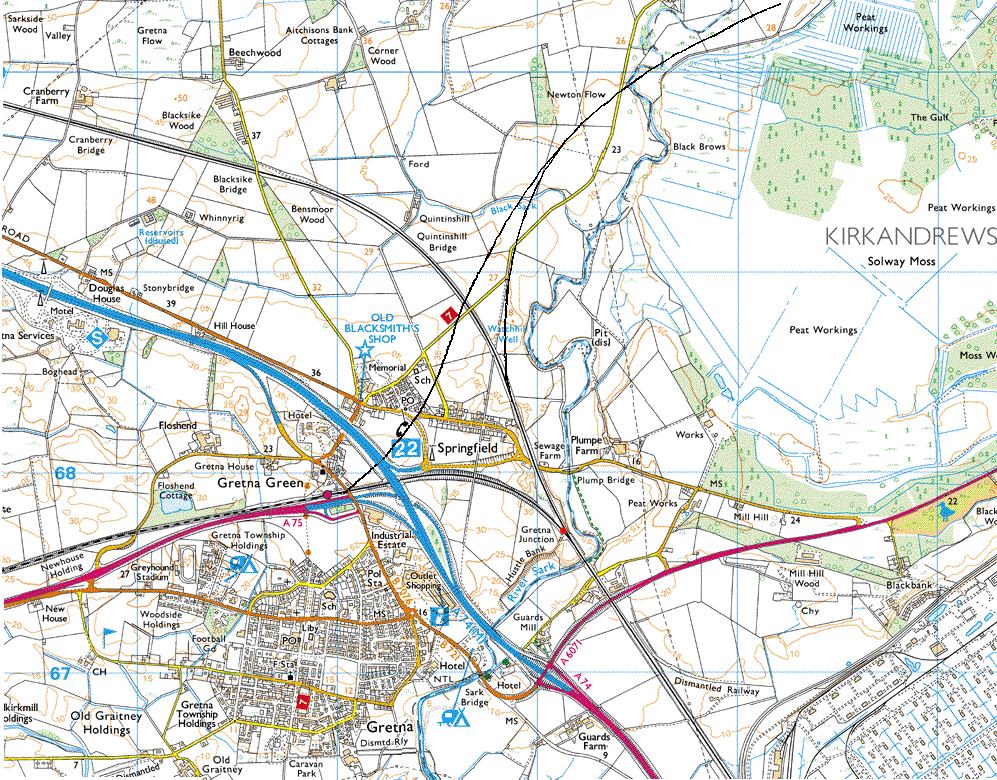
The layout I am building only achieves part of this concept and some things are the wrong side of the junction. At some point I will provide a better map of my version of reality.