In May 2025 we visited New Lanark Mill, a UNESCO World Heritage Site 25 miles southeast of Glasgow.
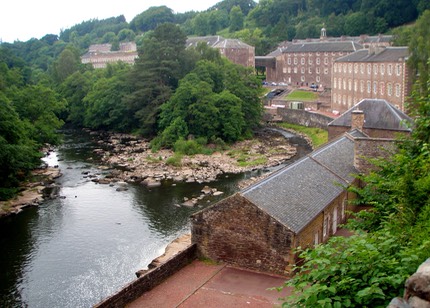
Reading about the Mill and Village beforehand I discovered it was founded by David Dale, a philanthropist. I had never heard of Dale and wondered why he was a philanthropist. Subsequently I was given a book in the Railway Detective by Edwards Marston. In the book there is a passage about the founding of New Lanark Mill.
Mr. Appleby, a prominent philanthropist in “Christmas Case” by Edward Marston was speaking to the generally infallible Railway Detective, Edward Colbeck.
“Does the name of Robert Owen mean anything to you inspector” “Yes, of course” said Colbeck. “I remember him well. He was given a share of his father-in-law’s Mills in New Lanark and made himself the dominant partner. Owen believed that, if you treat employees well, you get the best results out of them.” “Exactly!” “He not only gave them a decent wage, he built a model factory, a model village and a model school for them.” “His example inspired me,” said Appleby.
The opinion attributed to inspector Colbeck is common. This is not least because Robert Owen, the famous political philosopher, social reformer and founder of utopian socialism, liked to promote himself and to belittle the achievements of his father-in-law, David Dale. But, what kind of man was the true benefactor and founder of the model factory, village and school at New Lanark Mill?
This articles was written as a talk for the Withnell Mother’s Union in November 2025, however, due to the illness of one of the MU the talk was not delivered until January 2026.
All over New Lanark Mill there was lots about Robert Owen and his beliefs, but in the reception area, although there was stuff about David Dale and that he was a philanthropist, but no mention is made of his beliefs.
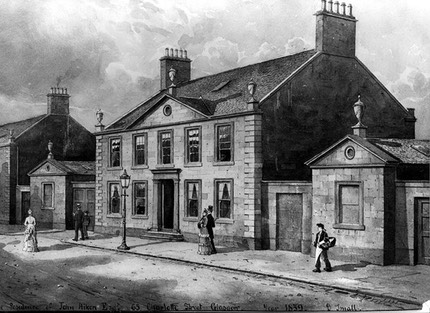
Along with lots and lots of workers tenements, there are two substantial houses. David Dale’s house seems to be permanently closed and the Trust that runs the site has very little to put in it, because little has survived.
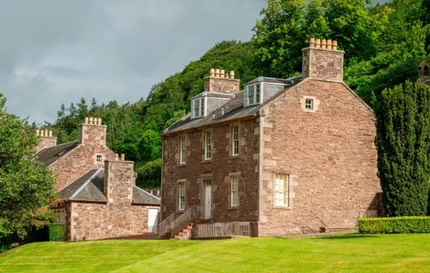
Robert Owen’s house, pictured, is open and has some of his furniture and lots about him.
Owen had married David Dale’s daughter and clearly had a good Christian upbringing but later rejected his faith and went to great efforts to rubbish David Dale’s work and beliefs. And to promote himself and his own view.
In Owen’s house there was a folder, just a small folder, with a bit about David Dale, which I read through, and finally found mention of what lay behind his philanthropy, his Christian faith.
I later spoke to someone who had been brought up on a farm in a neighbouring valley to New Lanark. Although he had heard of David Dale, neither nor his brothers knew that Dale was the founder, or that Dale was a Christian.
But I decided to find out more about Dale, and discovered there has been no significant biography until one by David J McClaren written in 1999. Now out of print, but available second-hand. I have done no research in source documents myself, relying only on the internet and McClaren’s book.
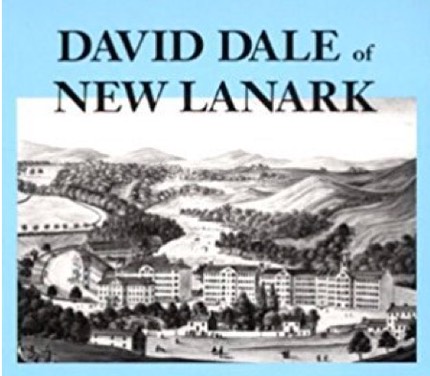
The biography says that Robert Owen had a very negative view of his father-in-law David Dale whereas most people spoke very highly of Dale. He was described as a genial and humorous man.
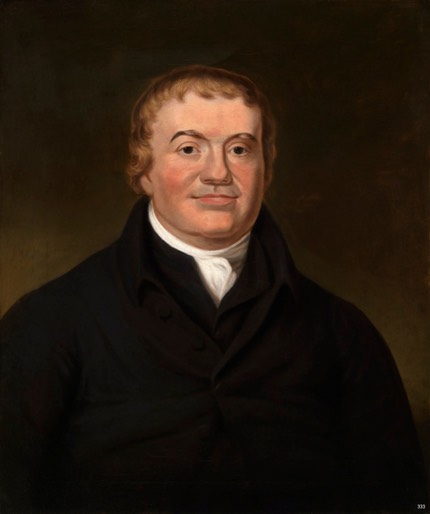
But Dale himself wrote little because he was so busy. McClaren relied on anecdotal evidence from other sources, which he documents faithfully. However, my impression is that McClaren did not really understand Dale’ faith.
Biography
Dale was the son of a grocer and general dealer, born in Ayrshire in 1739. He served an apprentice as a weaver in Paisley. New Lanark Mill would be a cotton mill, so you can see where his background would take him.
By the age of 24 he was working with working with another member his church running a shop in the commercial district of Glasgow. Seven years later he was trading under his own name and by the age of 38 was married to Anne Caroline Campbell, the daughter of a director of the Royal Bank of Scotland.
He was soon an agent of the Bank handling large amounts of other people’s business and running a textile business.
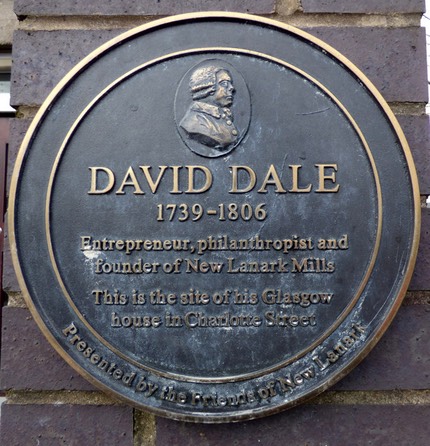
In 1783 Dale bought a substantial piece of land in Charlotte Street in Glasgow, which would become the posh street, a new house was built and he and the family moved there.
He helped found the Glasgow Chamber of Commerce and was later its Chairman.
Arkwright
If you know your industrial history you will have heard of Richard Arkwright, from Preston, who invented his Spinning Jenny in 1769. He opened the Cromford in Derbyshire, but began to face hostility and riots.
Dale and Arkwright met at a dinner in Glasgow for bankers and industrialists. The following day Dale took Arkwright to what would become the site of New Lanark Mill.
They entered into partnership, but it was dissolved a few years later, though the reason for that is not known.
There were problems with land, but New Lanark Mill began operating in 1785.
Dale soon had a reputation for his concern for the welfare of his workers, including their spiritual welfare.
When the first mill burned down he kept paying the staff until the new mill was operating.
It seems that some workers did leave because of the strict regime and Dale’s attitude to the Sabbath and drink.
By 1791 there were 981 people employed and within a few years ten and a half thousand.
Dale established a school to teach children and had become famous for the good conditions the care for his workers.
Legislation has changed much since, but Dale was motivated by his own concern for people.
In the years that followed he founded or became a partner in other mills in Scotland.
He was a director of the Glasgow Human Society, a manager of the Royal Infirmary and a Baillie and Magistrate. He was too busy to continue the latter after 2 years but by then gained a reputation in the press for his leniency and became known as ‘The Benevolent Magistrate’
Powerpoint Plaques to David Dale
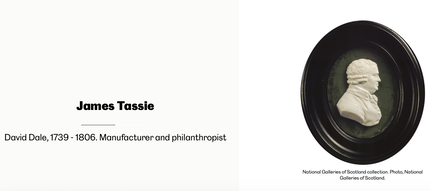
New Lanark was a Cotton Mill, and it relied on cotton grown in slave plantations in the West Indes, North America and South America. Dale’s wealth came from slavery.
I don’t think the book mentions this, but the Glasgow Museum do. In 1791 Dale was one of founders, and chairman of the Glasgow Society, which was
‘instituted for the purpose of co-operating with the other Societies in Great Britain, in their endeavours to effect the
Abolition of the African Slave Trade’
All this was before 1797 when Robert Owen first visited New Lanark. Owen met Caroline Dale and became the works manager. They were married a couple of years later and in 1801 Owen bought New Lanark Mills as Dale was in the divesting himself of his business interests to concentrate of other things.
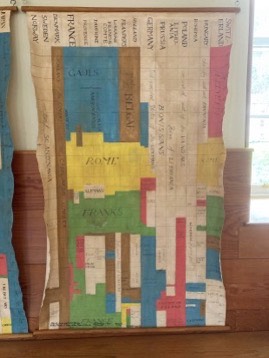
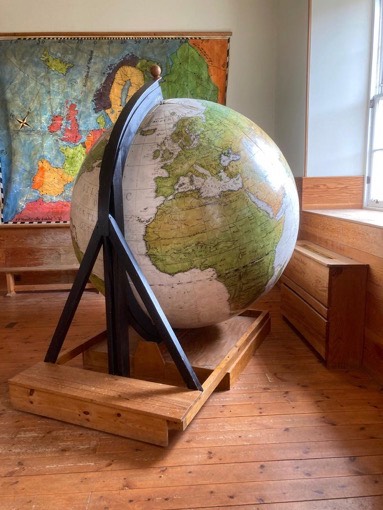
Owen took on the school that Dale had established and radically changed the teaching. The schoolroom is impressive for its times, but this talk is about Dale and his faith.
Motivations
Just to be clear, though Dale’s faith did drive a lot of what he did, his concern for workers was also motivated by the conviction that happy workers make more productive workers. Also, that educated children can be more valuable for society.
And good health care, such as provided by the Glasgow Royal Infirmary, would ensure workers were healthier.
But in difficult times, he would also buy food and sell it to people at a loss, in order to ensure they were well fed.
What of Dale’s faith?
McClaren gives the title to this chapter of the book “Evangelism”. He does so because he says that Dale was a keen member of the evangelical party of the Presbyterian Church in Scotland, and because Dales was concerned to personally share his faith with others, he was not just an evangelical (holding to evangelical doctrine), but aso an evangelist (himself active in sharing the gospel of salvation through faith in Christ alone).
McClaren writes:
"he believed that it was his duty to spread the word as far as possible and to practice what he preached. His Christianity for him was not something aesthetic and part time but a firm set of convictions upon which to base his life”.
Sources say that Dale was part of Presbyterian church when an apprentice.
The Presbyterian Church is the established Church of Scotland, like the Church of England it is supposed to be protestant and reformed, that is Calvinistic. Though they don’t have Bishops in the way that the Church of England does.
Years later Dale was part of College Church in Glasgow, part of the Presbyterian Church.
When an appointment of a new minister was to be made the local meeting of Presbyters would make
the appointment.
Liberalism at College Street
But in 1764 the Magistrates and Town Council of Glasgow ordered that they should appoint the ministers in Glasgow. This was a flagrant abuse of power.
The first vacancy to arise since the decision was made was that at Dale’s Church. The Magistrates appointed someone who was theologically liberal, which means they did not abide by the Protestant Reformed faith of the Church of Scotland.
Most of the congregation at College Church, and many others ,were outraged by this action, they challenged it in the courts, but lost.
Dale himself was one of the magistrates but he protested. When they magistrates dressed up to process to the church Dale refused to join them.
As a result of all this the orthodox party of which Dale was one of the leaders raised funds to build a new “Chapel of Ease” in Albion Street, and to appoint their first minister. This was still a Presbyterian church.
(Theological liberalism and Christianity are really two different religions, as was explained, a century and a half later, by Dr J Greshem Machen, an American Presbyterian, who founded Westminster Theological Seminary in Pensylvania.)
I should admit that this point but I found it difficult to fit together some of the dates in the book.
A few years later Dale encountered John Barclay who was an Independent and taught a Congregational form of Church government. (That is to say having nether Bishops, nor Presbyters, but ruled by the Congregation.)
Dale became convinced this was the true biblical model, as a result he and others left Albion Street. At first they met in private houses, including Dale’s own, and then they built a new Independent Church which could seat 500 people.
Dale became one of the elders and lay preachers of the new church. He preached in many other local independent churches in and around Glasgow.
As a result he found himself booed on the streets and had to take refuge in friendly houses.
The register of elders of the church also records his death 37 years later stating he died “after a long faithful ministry”.
It should be noted that though Dale changed his views on church government in other respects he was very traditional and pro-establishment, and was determinedly protestant, reformed and evangelical.
His attitude to work was typical of what would later become known as the Protestant Work Ethic, which it has been claimed had such an impact on Western Europe and later in the United States.
Here McLaren quotes a record of a “discourse” by David Dale which is in the Glasgow University Library:
“Diligence in business matters is a duty; but in this and in all things, we should be ‘fervent in spirit serving the Lord’, which cannot be the case if this duty is attended to at the expense of another more important”.
The quotation is from Romas chapter 12 verse 11
McClaren also writes about Dale’s views of salvation and here it would have been better if I had read the discouse myself.
The book seems confused about the relationship between faith and good works.
Dale believed, as our CorE Thirty Nine Articles of Religion do, in election, that people are saved by the grace of God, but that we are called by God to make known His word, and as a preacher Dale did that.
That seems to have been a key part of his concern for education, so that children could read the Bible, and he ensured that the gospel would be preached in his mills or churches on site.
He also saw that faith must be personal and that people can have an assurance of faith.
Conclusion
I would like to have read more of what Dale himself wrote, but there appears to have been little written.
He certainly could be a tough businessman and was willing to take a stand on issues of conscience.
His concern for the welfare of others often did have a knock on benefit for his own business.
But he gave away a lot of money to all sorts of causes and devoted a lot of time to welfare concerns.
I think that what comes across is a deep personal faith, that was lived out in concern for others and good works. That showed itself in many practical
So I will close with some words from that letter of Dale to his wrote to his father after the death of one of his daughters as a young girl.
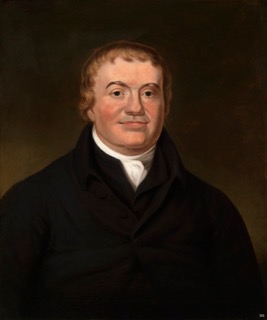
In the book they are hand written copies which are hard to read but include quotes from Isaiah 49 verse 8 and Hebrews 2 verse 3:
“we are called to hear and believe the Gospel of Christ
now is the acceptable time; now is the day of salvation
today let us hear the voice of Christ
How shall we escape, if we neglect so great salvation”
David Phillips 1 March 2026